How to check an AI answer
You need: ChatGPT (chatgpt.com), a browser
The biggest trap with AI is that it says wrong things with the same confidence as right ones. OpenAI itself writes that its models “hallucinate”: they produce plausible but false statements. Its explanation is that training and evaluation reward guessing over saying “I don’t know”, the way guessing on a multiple-choice test scores better than leaving a blank.
Where AI is good, and where it isn’t
In a Harvard Business School and BCG experiment, 758 consultants did realistic work, some with AI and some without. On tasks inside AI’s abilities, the AI users finished 12.2% more tasks on average, 25.1% faster, at higher quality. But on one task outside those abilities, the AI users were 19% less likely to reach a correct solution.
The researchers call this the “jagged frontier”. Of two tasks that look equally hard, AI may be excellent at one and wrong on the other, and it’s hard to tell in advance which is which. That’s why the habit of checking is what matters.
Now a real test: we ask ChatGPT for a list of research papers, then check it.
Step 1: Ask for an answer with sources
Don’t just write “tell me”; write “give links” or “give sources”. Then you have a way to check the answer.
Give me 3 research papers about the use of AI in education in Bangladesh, with title, authors, year and link.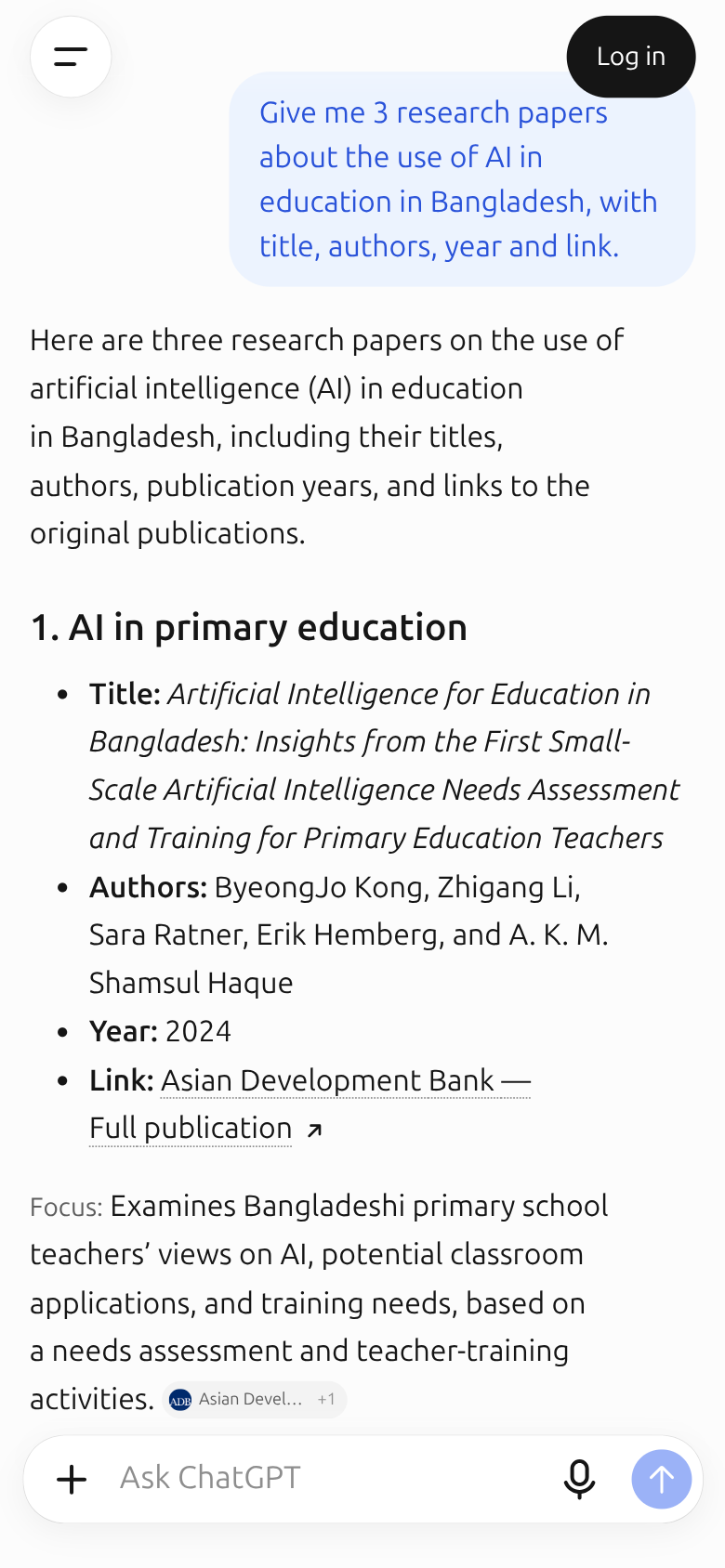
- 1Paper title, authors and year; the source link below
ChatGPT searched the web and gave three papers, each with a small source link.
Step 2: Ask which ones it is sure of
In the same conversation, ask what it is certain about, and give it room to say “I don’t know”.
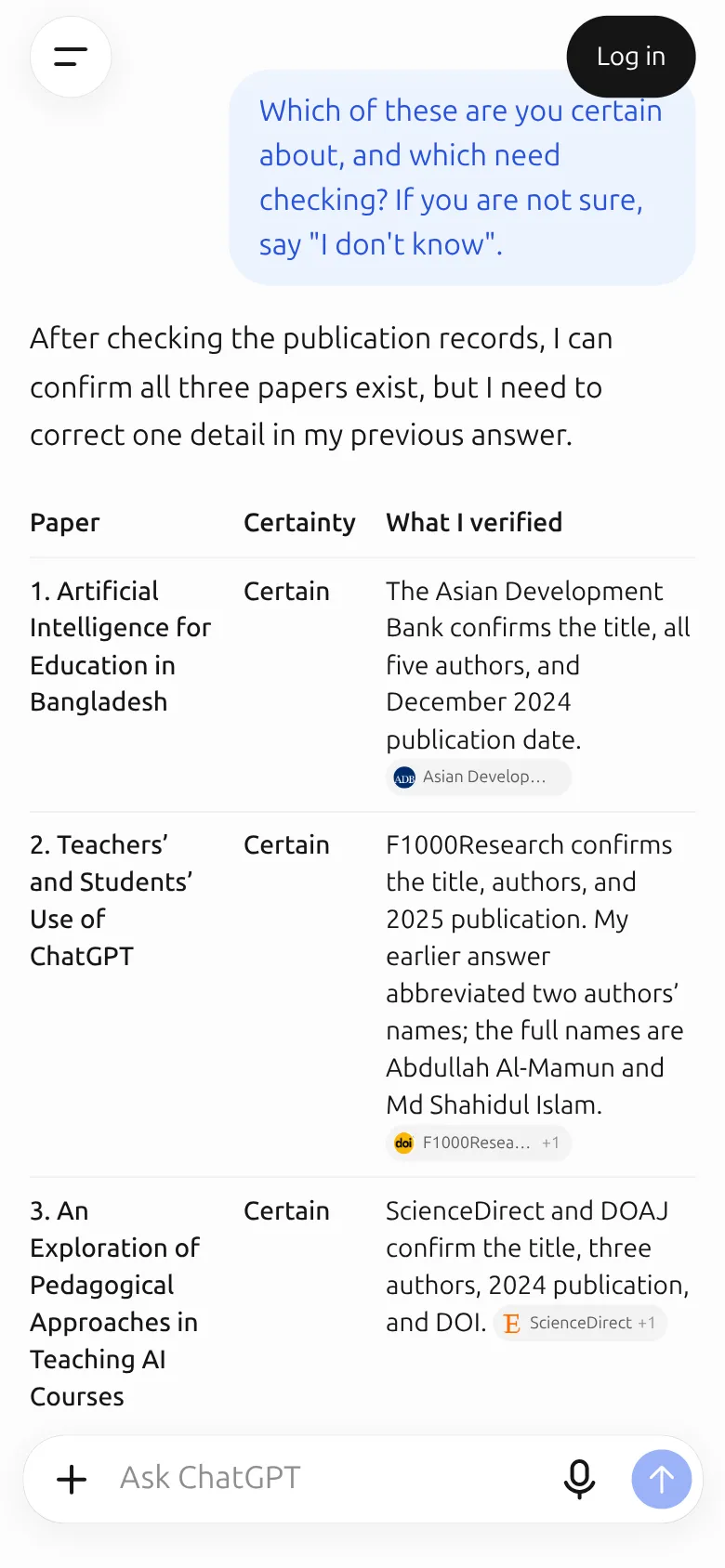
Which of these are you certain about, and which need checking? If you are not sure, say "I don't know".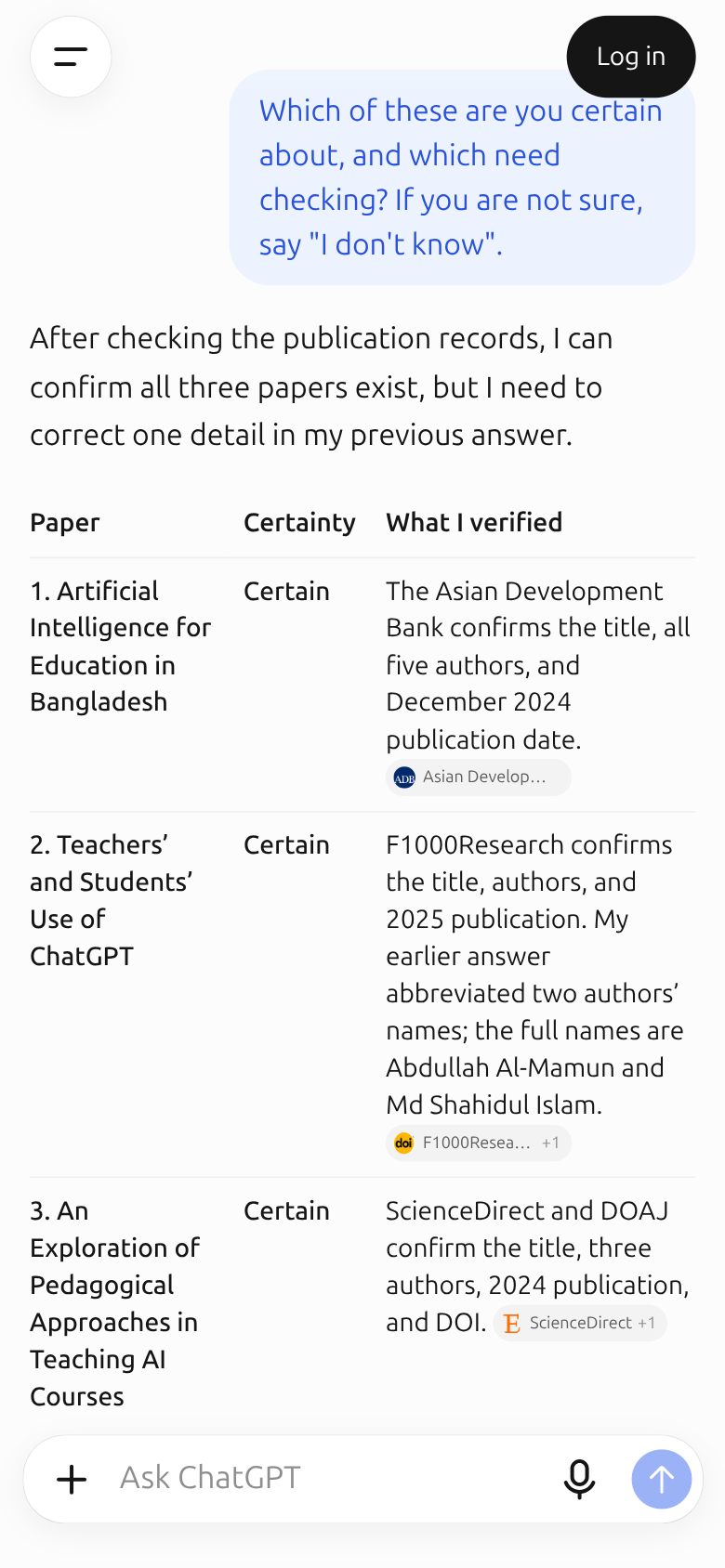
- 1A separate check result for each paper
ChatGPT checked the publication records again and answered paper by paper. And it corrected itself: in the first answer it had shortened two authors’ names, and now gave the full names. Without the second question, that slip would have gone unnoticed. It also named its own limit: the papers exist, but it hasn’t assessed their methods or quality, and the third one is about teaching AI as a subject rather than using AI to teach.
Step 3: Open the link and compare
The last step is yours. Open the first link and check that the title, year and publisher match.
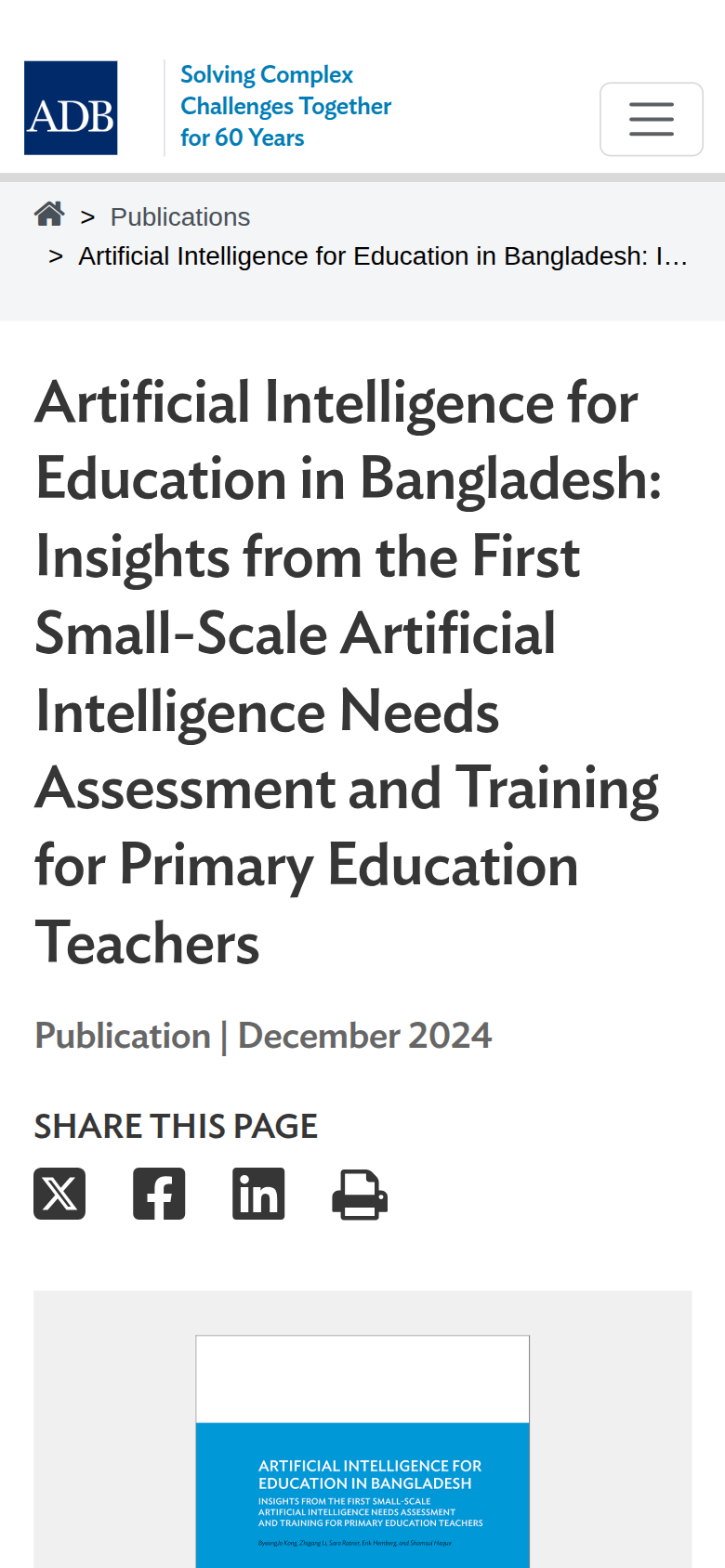
The Asian Development Bank page shows the exact title, published December 2024, as ChatGPT said. (In one of our runs the site first showed a “verify you are human” check; that’s normal on some sites.) We also searched for the other two papers separately: all three really exist.
This time ChatGPT was right. But we only knew that after opening the links, not before.
When to always check
- Numbers and prices: fees, interest rates, price calculations.
- Laws, rules and government services: passports, tax, admission rules. Always compare with the official page.
- Health and medicine: not a replacement for a doctor.
- Quotes and references: who said what, which book it’s in.
- News and recent events: what the AI knows may be out of date.
Sources
- OpenAI, Why language models hallucinate (September 2025): what hallucinations are, and why they happen.
- Dell’Acqua, Mollick and others, Navigating the Jagged Technological Frontier (Harvard Business School Working Paper 24-013, 2023): the experiment with 758 consultants and its figures.
- Big Think, Ethan Mollick’s four guiding principles for using AI at work (2026): a summary of the principles from Mollick’s book Co-Intelligence.
- Asian Development Bank, Artificial Intelligence for Education in Bangladesh (December 2024): the first paper checked in this test.
Screenshots and steps checked: . AI answers can be wrong. For anything that matters, such as money, health, law or exams, always check against the original source or an expert. Never give any AI your password, PIN, national ID or bank details.