Facebook page posts and customer replies, with AI
You need: ChatGPT (chatgpt.com), your product facts: size, price, delivery charge
If you sell on a Facebook page, a lot of your day goes into writing posts and answering the same questions. AI can make the writing faster. One condition: you give the real facts, the AI only arranges them. As an example we use a page that sells handmade nakshi kantha quilts.
Step 1: Give every product fact at once
Open chatgpt.com (no login needed; if it’s your first time, see the first-task post). The request has four parts:
- What you sell: the product and its kind.
- The real facts: size, fabric, price, delivery charges, payment rules.
- Tone and length: “simple, warm language, within 80 words”.
- One ban: “do not make up any fact that is not given here”. Without it, the AI may add claims like “limited stock” or “best quality” on its own.
I sell handmade nakshi kantha quilts on my Facebook page. Write a post for a new quilt. Facts: size 7 x 5 feet, cotton fabric, price 3,200 taka. Delivery charge 80 taka inside Dhaka, 150 taka outside Dhaka. Cash on delivery is available. Simple, warm language, within 80 words. End with how to order. Do not make up any fact that is not given here.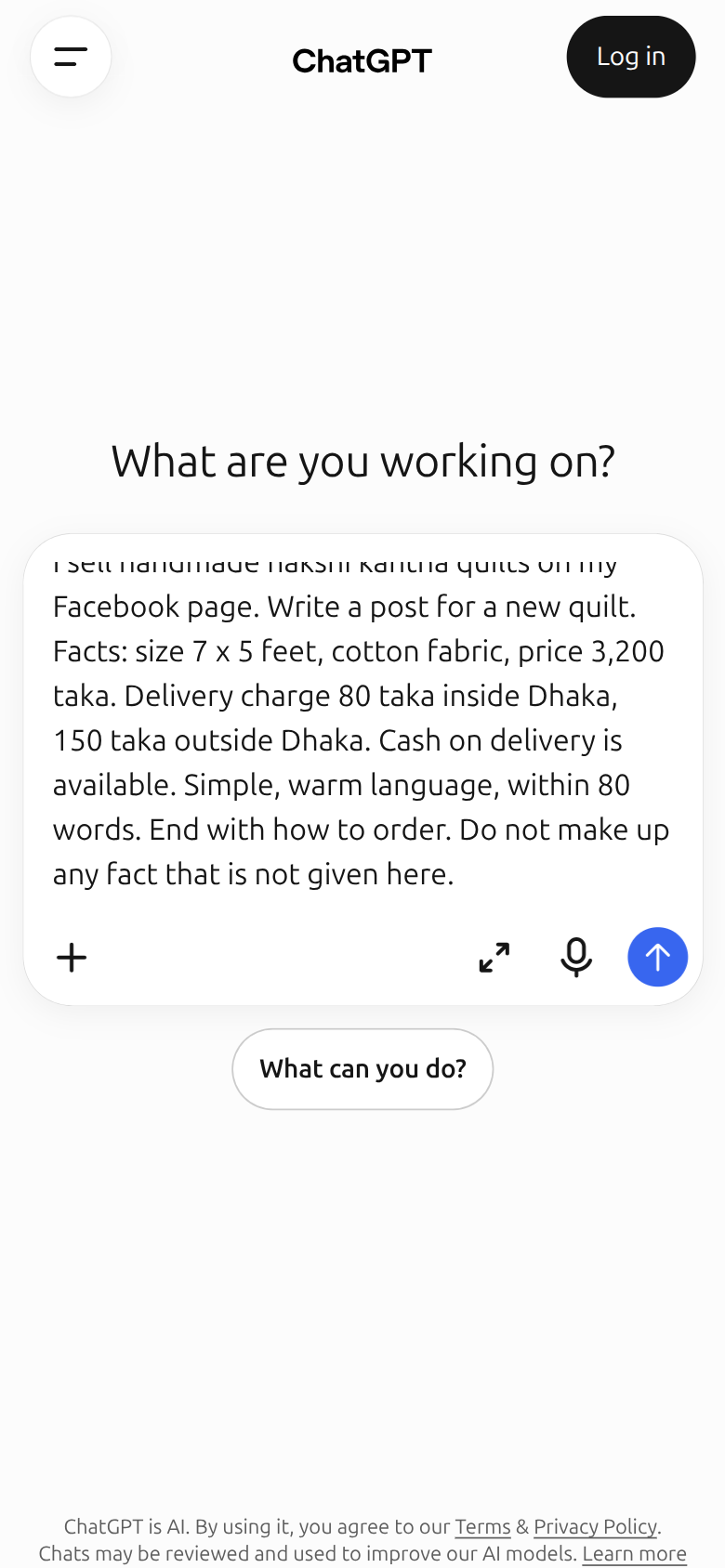
- 1The request with every product fact
- 2Send button
Step 2: Check the post against your facts
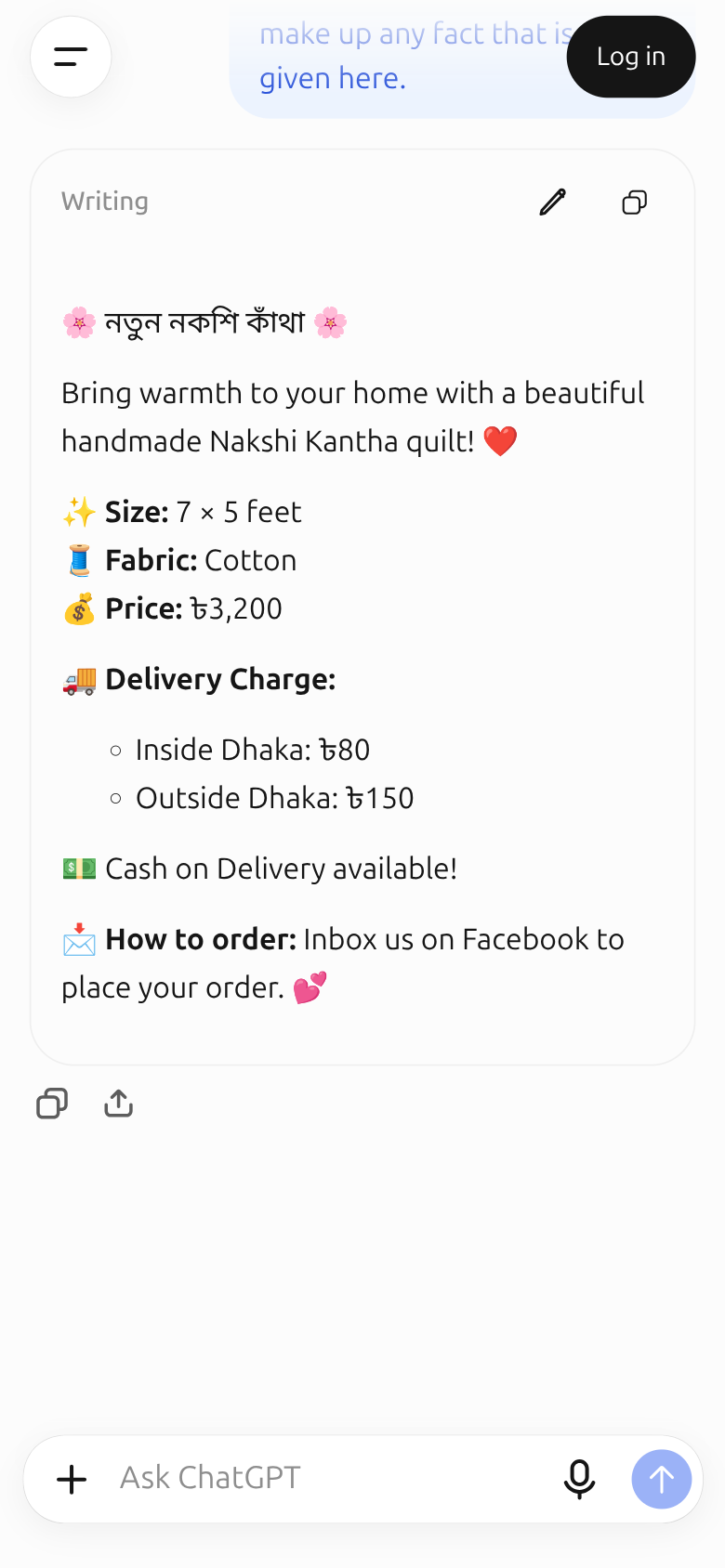
- 1The finished post: size, fabric, price and delivery charges
Size, fabric, price, both delivery charges and cash on delivery: all correct. Now look at two things:
- The last line says “Inbox us on Facebook to place your order”. We asked it to say how to order, but never gave the method, so ChatGPT assumed one. If you take orders by phone or WhatsApp, put that in the request.
- The heading came out in Bangla (“নতুন নকশি কাঁথা”) although the request was in English. If you want one language only, say so.
The rule is simple: every fact in the post must be in your request. Otherwise the AI fills the gaps with guesses.
Step 3: Have it draft a reply to a customer
In the same conversation, paste the customer’s message and state your decision. The AI doesn’t know whether you can lower the price or how long the courier takes. The decision is yours; the wording is the AI’s.
A customer sent a message: "Can you lower the price a little? How many days to Chattogram?" Write a polite reply using the facts above. The price cannot be lowered. I don't know the delivery time yet, so say I will find out and let them know.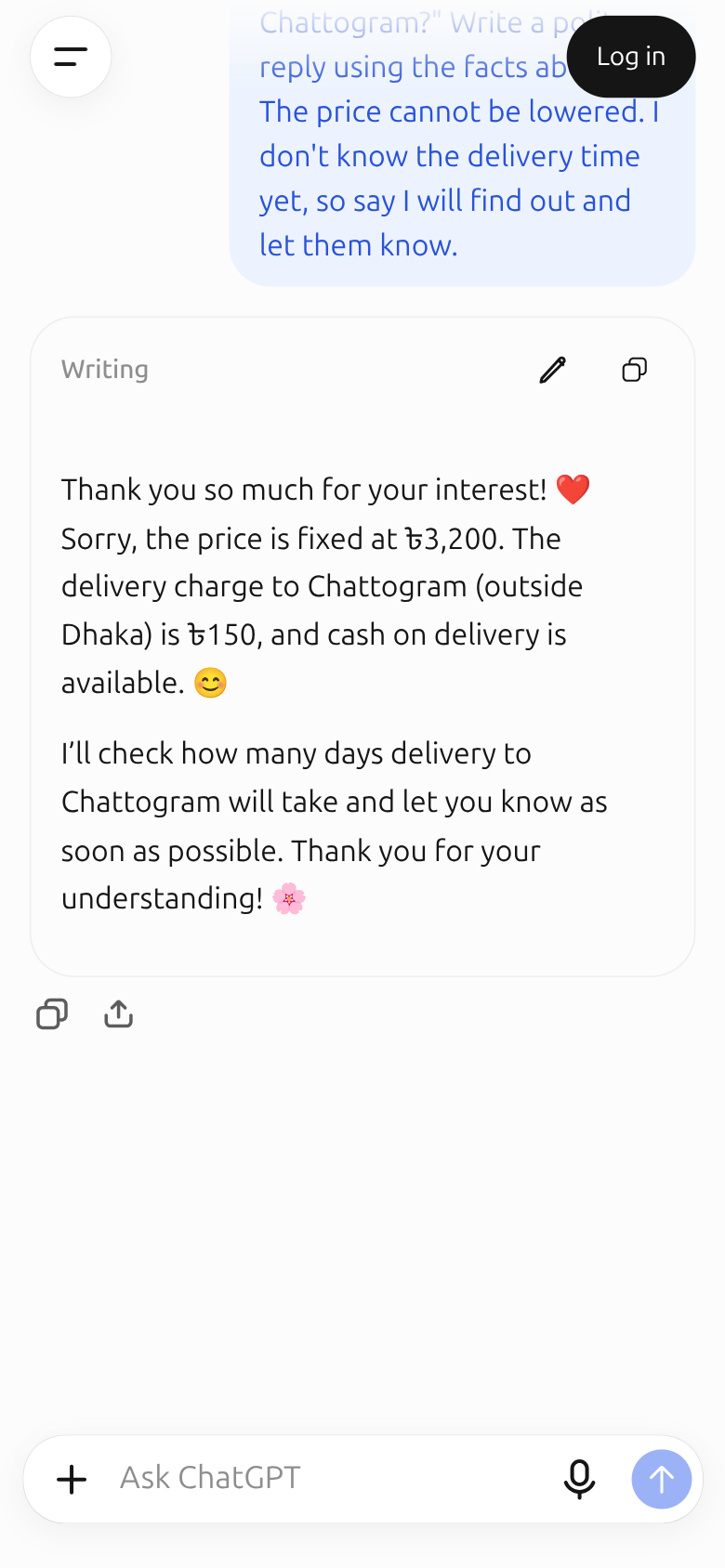
- 1A polite reply: price stays, 150 taka charge, delivery time to follow
The reply remembered the earlier facts: Chattogram is outside Dhaka, so the charge is 150 taka. It didn’t invent a delivery time. If you don’t like the tone, say “make it shorter” or “make it more formal”.
Step 4: Check three things before sending
- Price and charges: do they match your real prices?
- Promises: did the AI write anything you can’t deliver (free delivery, a guarantee, “arrives today”)?
- Customer data: don’t give the AI the customer’s name, phone number or address. A reply doesn’t need them.
Sources
- OpenAI Help Center, Prompt engineering best practices for ChatGPT: be clear and specific, and name the tone you want.
- Google, Prompting guide 101 (October 2024): prompt examples for small business owners and customer service.
Screenshots and steps checked: . AI answers can be wrong. For anything that matters, such as money, health, law or exams, always check against the original source or an expert. Never give any AI your password, PIN, national ID or bank details.